
The BirdsReturns Program
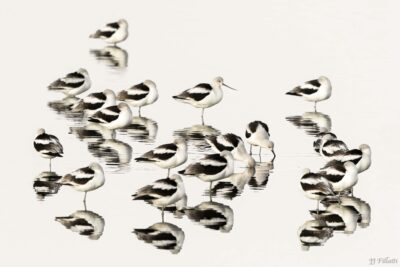
American Avocets©JoAnne Fillatti
A few years ago, seeing a big need for wetland habitat for migratory birds in the Central Valley, Audubon California, The Nature Conservancy and Point Blue Conservation Science partnered to develop the BirdReturns project. They identified places that birds historically used but now lacked enough wetlands, and developed a novel way of getting water back on them.
The partnership pays farmers and private wetland owners to flood their fields and create the temporary habitat shorebirds need. Farmers benefit from better soil, while birds find food and rest during migration. BirdReturns uses a combination of satellite imagery and on-the-ground observations to feed into a method that identifies when and where birds are likely to land. The satellite imagery is also used to verify that the habitat promised by their farmer contractors is actually delivered.
TNC uses a reverse auction, where farmers offer their best price to create bird habitat. Then TNC selects farmers who provide the best habitat in places that the birds are likely to land, at the lowest cost. The pilot program in 2014 created ten thousand acres of habitat across forty farms, and the number has grown each year. Properties in the Yolo Bypass have been in the program. BirdReturns normally runs in fall and spring, when habitat shortage is greatest. In the third year of drought in 2022, the program extended into winter.
This year the California Department of Fish and Wildlife has awarded a three-year, fifteen million dollar contract to the partnership to continue and expand the program. This is a lot of money for a single activity, and is a testament to the value and effectiveness of the work.
The program has grown to include new habitat types and geographies. For example, fields are flooded for foraging by sandhill cranes near known roosting sites in the Delta and Sacramento Valley. Audubon California also works with The Nature Conservancy to provide tricolored blackbird foraging habitat in the San Joaquin Valley.
For more information, visit The Nature Conservancy’s BirdReturns webpage here.
— Michael Perrone, Conservation Chair