
California Chaparral and its Birds at Risk
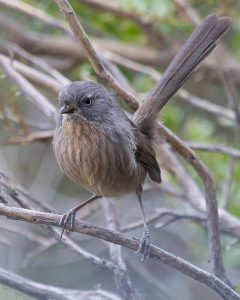
Wrentit ©Erna Tarara
Regardless of how we regard global warming or the climate crisis, there is no doubt that wildfires have grown massively in frequency and intensity in California in the twenty-first century. On the broad line of hills called the Blue Ridge in Yolo County and the Vaca Mountains in Solano County, there have been eight big fires since 1950. Five of those have occurred in just the last decade, far above the average number in any prior period.
Ascending the hills from the Sacramento Valley side, the vegetation was–until recently–mainly oak woodland and shrubby thickets. Today, much of the woody vegetation has been reduced to charred stumps in a background of annual grasses. Botanists know the shrub-land as Mediterranean chaparral, because this special kind of plant life was first described in that region. Worldwide it is narrowly restricted to hill-slopes in places with a so-called Mediterranean climate, one with hot, dry summers and cool, rainy winters. Outside California, the nearest patches are in Chile and Portugal. The dominant plants are mostly evergreen shrubs, typically with stiff branches and small, tough, thick, evergreen leaves. Good local examples are manzanita, buck-brush (Ceanothus), chamise and shrubby oak species. The plants grow in dense, impenetrable, and often extensive thickets.
Chaparral shrubs are well suited to occasional fire. New greenery sprouts from the stumps after a fire, and mature plants produce an ever-larger seed bank that can re-start the vegetation after a fire destroys it. The catch is that the slow-growing shrubs need decades to produce a big store-house of seeds. The current fire regime prevents this. Areas that burn once or more in a decade can never return to mature chaparral. And this spells trouble for birds.
Several Yolo County species are largely or entirely restricted to chaparral, particularly for nesting, including mountain quail, greater roadrunner, poorwill, blue-gray gnatcatcher, wrentit, California thrasher, Lawrence’s goldfinch, and Bell’s sparrow. It is also an important home for many other species, including Bewick’s wren, hermit thrush, spotted towhee, fox sparrow, golden-crowned sparrow and lazuli bunting. After a wildfire in 2020 burned most of the western half of the Putah Creek Christmas Count area, the numbers of California thrasher, wrentit and Bell’s sparrow on the Count crashed. Several other species can be expected to follow suit in the burned areas. We need birders to go up there and count birds, especially during nesting.
Thanks to Bart Wickel for information on wildfire frequency and Christmas count results on the Blue Ridge and Vaca Hills.
— Michael Perrone, Conservation Chair